Internal links: what Google documents, and what the click-weight theory does not prove
Internal linking advice now comes with specific claims: that link position and link clicks carry ranking weight. Here is what Google's documentation supports, what it does not, how to read 'Discovered – currently not indexed', and a test design for small sites.
Internal linking advice has become more specific over the past year. Put links higher on the page. Link from pages that already rank. Favour links people actually click.
Some of that is in Google's documentation. Some of it is inference from a patent, or from tests nobody has published. This review separates the two, then gives a method you can run on a small site without relying on either theory.
Sources checked October 13, 2026. This is an evidence review and a proposed method. It is not a ranking result, and it does not report a test of our own.
What Google documents
| Topic | What Google says | Source |
|---|---|---|
| Discovery | Google finds most new pages by following links from pages it already knows. Its Starter Guide says the vast majority of new pages it finds each day come through links. | How Search works; SEO Starter Guide |
| Crawlable format | Google can generally crawl a link only if it is an <a> element with an href. Links inserted with JavaScript work if they use that markup. Script-only "links" may not be followed. |
Link best practices |
| Coverage | Every page you care about should have a link from at least one other page on your site. | Link best practices |
| Anchor text | Descriptive, reasonably concise and relevant to both pages. The words around the link give it context. Do not chain links side by side. Stuffing keywords into anchors breaks the spam policies. | Link best practices |
| How many | There is no ideal number of links per page. If it feels like too many, it probably is. | Link best practices |
| Sitemaps | Most useful when a site is large, new with few external links, or not comprehensively linked. Sites of about 500 pages or fewer that are well linked may not need one. | Sitemaps overview |
| Weight | PageRank uses links and is one of many ranking signals. | SEO Starter Guide |
| Your data | The Links report lists your most internally linked pages and which pages link to each. | Links report |
Two points follow directly. A page that nothing links to is relying on a sitemap or external links to be found.
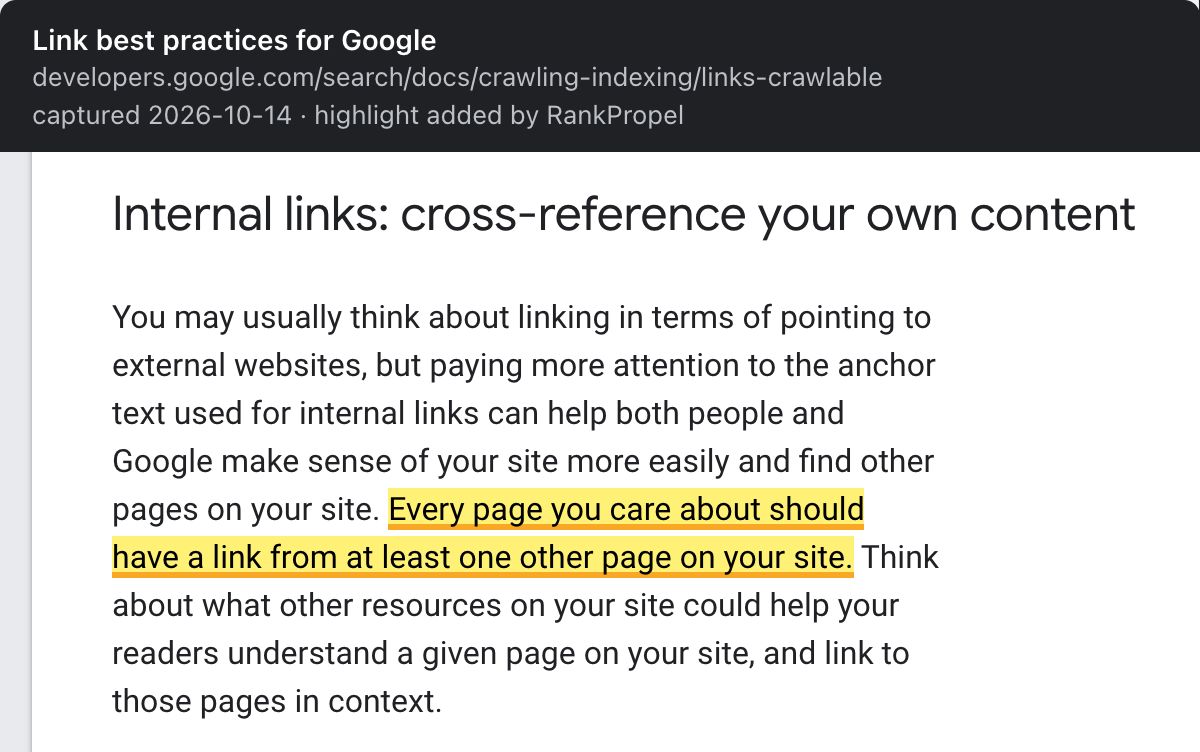
Source: Google Search Central, Link best practices for Google, captured October 14, 2026. Highlight added by RankPropel. Licensed CC BY 4.0.
Links built with buttons or click handlers instead of href may be invisible to Google.
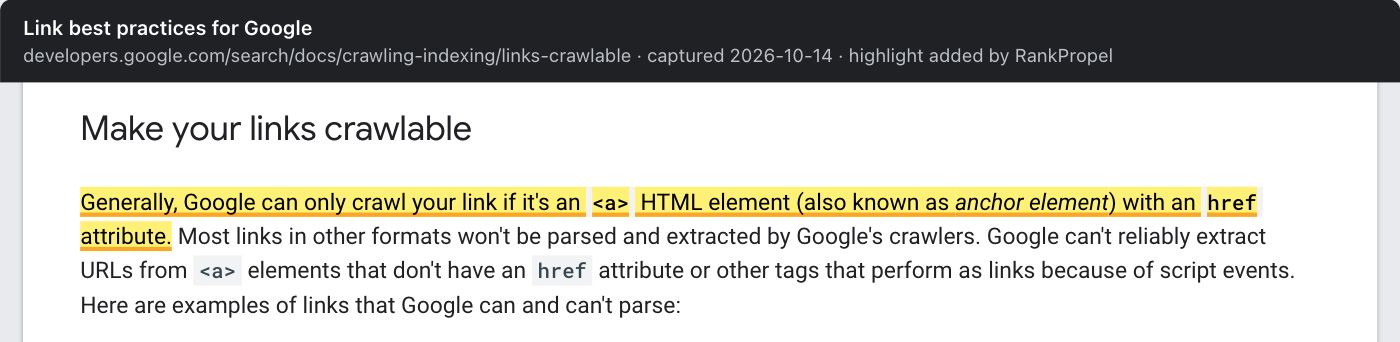
Source: Google Search Central, Link best practices for Google, captured October 14, 2026. Highlight added by RankPropel. Licensed CC BY 4.0.
What Google does not document
Link position and link clicks
A widely repeated claim says that links near the top of a page pass more value than links lower down, and that internal links people click carry more weight. It is usually backed by anecdotal before-and-after tests and by a Google patent, US7716225B1, "Ranking documents based on user behavior and/or feature data", which describes weighting links by the predicted likelihood that a user follows them.
What that evidence does and does not establish:
- The tests behind the claim are rarely published with a method, a control group or data. Without those, a ranking change after a link change cannot be separated from everything else that changed.
- The patent was filed in 2004 and published in 2010, and Google Patents lists it as expired. A patent shows that Google engineers designed a method. It does not show that Google uses it today, or how much weight it carries.
- Google's documentation says nothing about link position or internal link clicks as ranking inputs. Google does say it uses aggregated, anonymised interaction data to judge whether search results are relevant. How results are ranked. That is about clicks on results, not on links inside your pages. For what the antitrust trial record says about result clicks, see Do clicks rank pages?
The idea is plausible and unproven. It is not a reason to redesign navigation. A link placed where readers need it tends to be a link they use anyway, which is the advice Google's anchor-text guidance already gives.
"Change your internal links monthly"
Some practitioners advise reviewing and changing internal links on a regular schedule, based on whether the pages they point to rank and earn clicks. Reviewing links is sensible maintenance. We found no Google documentation that rewards changing links on a schedule. Change a link when the destination has changed or a better page exists.
"Discovered – currently not indexed" means weak links
This status is often explained as a page lacking enough link equity. Google's definition is narrower: Google found the URL but has not crawled it yet, typically because crawling then was expected to overload the site, so the crawl was rescheduled. Page indexing report.
Google's crawl-budget guide is written for large sites and sites where a large share of URLs sit in this status. It says each hostname has its own crawl budget, shaped by how much your server can take and how much Google wants to crawl. Pages that are more popular on the web tend to be crawled more often. Crawl budget. That leaves room for links to matter, through popularity and discovery, but Google does not say the status is a link-equity verdict. On a small site, check server response times and errors as well as internal links before concluding either way.
"Crawled – currently not indexed" is different. Google crawled the page and chose not to index it for now. Resubmitting does not help. Google says the page may or may not be indexed later. Page indexing report.
Linking from pages that already rank
A common pattern is to find a page that already ranks, find the sentence on it most related to your target page, and link that phrase. A sensible version of the advice avoids using the exact target keyword as anchor text everywhere, because it reads unnaturally and people are less likely to click it.
That pattern fits Google's documentation well: contextual placement, descriptive anchors, no stuffing. The part that is not documented is how much ranking value moves through the link. The reasons we can defend are practical. Pages that already rank are crawled and read, so a link there gets discovered and used.
A method for small sites
- Inventory. Export the Links report's internal links table. Compare it with your sitemap: any sitemap URL with no internal links is an orphan. Fix orphans first; Google's guidance on coverage is explicit.
- Check the markup. For a sample of navigation and in-content links, confirm they are
<a href>elements in the rendered HTML. If JavaScript inserts them, check the rendered page with the URL Inspection tool. - Pick source pages. In the Performance report, find pages with impressions that are topically related to the target page. Relevance comes first; a popular but unrelated page is a poor source.
- Place one link where a reader needs it. Use a descriptive phrase that would make sense out of context. Keep the surrounding sentence. Avoid repeating identical exact-match anchors across many pages.
- Test before you scale. Take a set of comparable pages with a shared problem, for example pages stuck in "Discovered – currently not indexed" or with low impressions. Add links to half, chosen at random, and leave the rest alone. After four to eight weeks, compare indexing status and impressions between the two halves. A single before-and-after on one page cannot tell links apart from everything else that changed.
Checklist
- Every page you care about has at least one crawlable internal link
- Links are
<a href>elements in the rendered HTML - Anchors are descriptive and read naturally; no chained or stuffed anchors
- New links come from related pages that already earn impressions
- "Discovered" pages checked for server capacity as well as links
- Changes tested on half a matched set before rolling out
Related: Mining Search Console queries for pages that already rank and From zero to indexed: a launch-day checklist.