Show the source: how we cite Google's documentation with highlighted evidence
Why RankPropel puts highlighted, dated screenshots of Google's own documentation next to important claims, how we capture them, the licence that allows it, and what a screenshot cannot prove.
A link asks the reader to trust that the page says what we claim. A highlighted screenshot shows the sentence, the page it came from and the date we read it. When an article depends on what Google's documentation says, we now add a small number of these images next to the claims that matter most.
This is a reader-trust practice, not an SEO tactic. Evidence images are not a ranking factor, and we don't expect them to change rankings or AI citations.
Why we do it
Google's guidance on helpful content asks writers to judge their own pages with questions like this one:
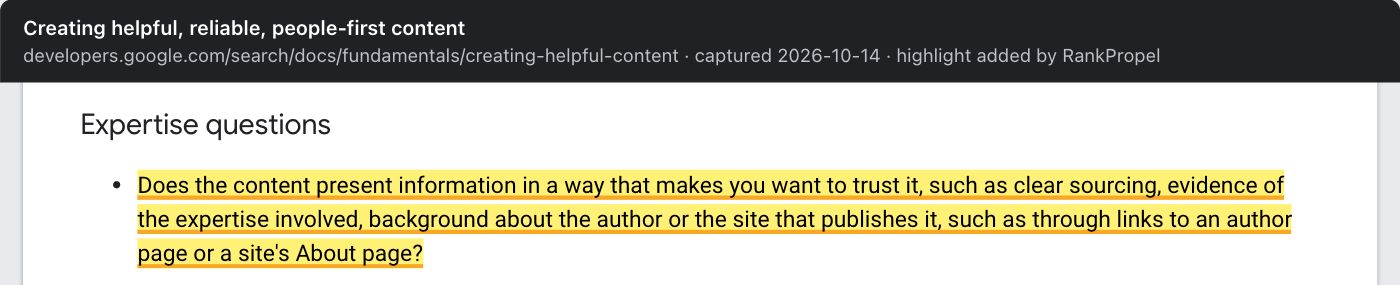
Source: Google Search Central, Creating helpful, reliable, people-first content, captured October 14, 2026. Highlight added by RankPropel. Licensed CC BY 4.0.
The same page says that E-E-A-T itself isn't a specific ranking factor. We read the question as a description of what readers need, not as a scoring rule. Most of our articles are about what Google documents and what it doesn't, and paraphrase is where errors creep in. Showing the original sentence lets a reader check our reading in a few seconds, and it makes our own mistakes easier to catch.
How we capture a source
- Pick the claims that carry the article. Requirements, definitions, things Google says it does not do, and anything a reader might doubt. One to three images per article; everything else keeps an ordinary link.
- Find the exact sentence on the live page. If the sentence only partly supports our claim, we rewrite the claim.
- Capture with a script. It opens the page in headless Chrome, finds the passage word for word (only differences in whitespace are ignored), highlights it, and crops to the nearest heading and the surrounding paragraph. A dark bar above the crop shows the page title, URL, capture date and "highlight added by RankPropel". If the sentence is not on the page, the script stops with an error and produces no image. We don't edit images afterwards.
- Keep a record. For each image we keep a private manifest with the URL, the exact on-page text, the page's own "Last updated" date, the capture time and a SHA-256 hash of the image.
- Publish with context. Each image sits after the paragraph that makes the claim. The alt text describes the page, the section and the highlighted words, so screen-reader users get the same evidence. The caption links the page, gives the capture date, notes the added highlight and states the licence. The article text still makes its point without the image.
- Re-capture when the page changes. At each review we re-run the capture. If the sentence has gone, the claim needs checking again before anything else.
You can see the result in our October 2026 Google guidance review, the evidence-led method and our article on DA, DR and Trust Flow.
Why this is allowed
Google licenses much of the documentation on Google Developers, including the Search Central pages we cite, under Creative Commons Attribution 4.0, with code samples under Apache 2.0:
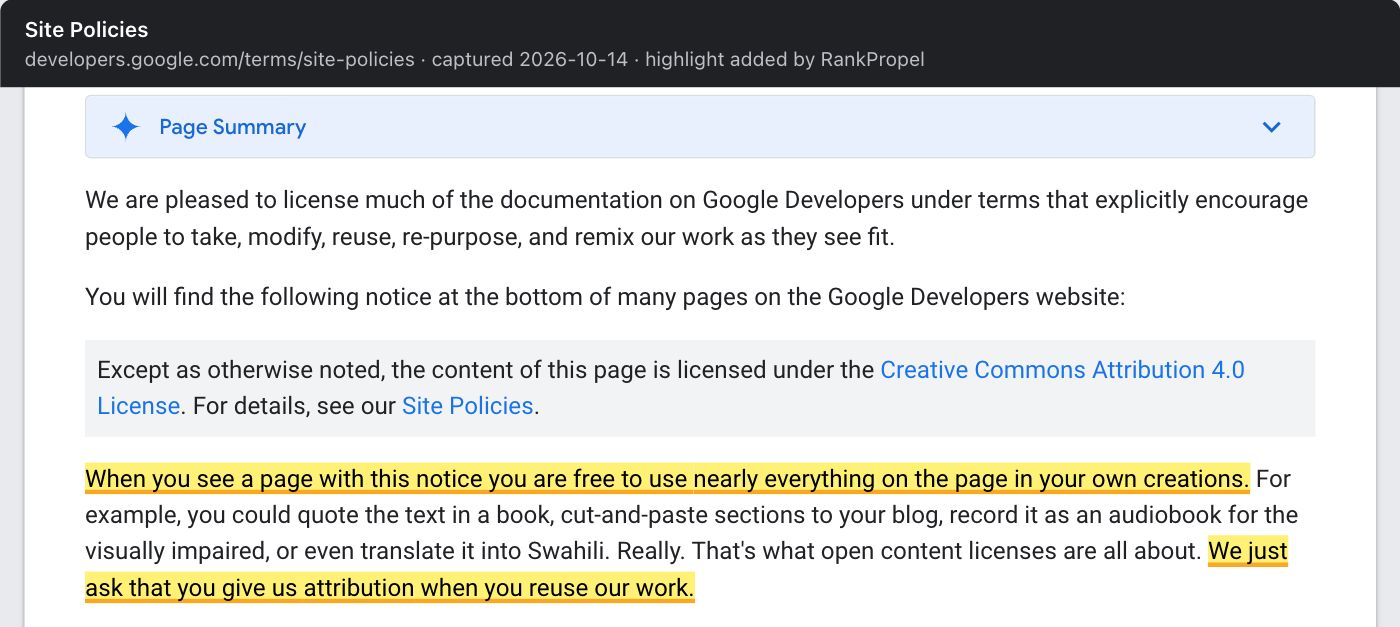
Source: Google for Developers, Site Policies, captured October 14, 2026. Highlight added by RankPropel. Licensed CC BY 4.0.
The same page sets limits. Google's trademarks and brand features are not covered, and neither are images, audio, video or linked material on a page unless the page says so. We check that each page we capture shows the CC BY notice, crop to the text, and keep logos out of the frame. We don't publish screenshots of third-party sites, whose terms differ.
What a screenshot cannot prove
- That we interpreted it correctly. The image shows what Google wrote. Whether it supports our conclusion is still an argument the article has to make.
- That it is still current. Documentation changes. The capture date and the link let you check the live page, and the live page wins.
- That the image is genuine. Images can be faked. The link is the real check; our manifests and hashes let us show what we captured if asked.
- Anything about other search engines or AI services. A sentence from Google's documentation describes Google.
For agents and teams
The workflow is available as the source-evidence playbook in RankPropel's agent service. Your agent runs the capture in its own environment and edits your content; RankPropel's server gives the steps and never takes screenshots or touches your site.