Case study: preparing a long-form guide for Google's AI features before launch
A redacted case study by LIPAI WANG: applying Google's October 2026 guidance on AI content, images and human review to a long-form guide before it went live.
This case study documents work by LIPAI WANG on an owner-operated publication: a long-form B2B reference guide with a companion book. Its name, domain and subject are withheld. It is labeled Case C and is not presented as a client endorsement.
The work happened before launch, so this is an implementation record. It shows what was checked, what changed and how each change was verified. It does not show traffic, rankings or AI citations, because there were none to measure yet.
The guidance being applied
Google updated two core documents on October 1, 2026. Using generative AI content now points to the rater guidelines on scaled content abuse and low-effort content, and asks publishers to fact-check automated output, including titles, meta descriptions, structured data and alt text. Creating helpful content restates who, how and why: real bylines, honest disclosure of automation, and content made mainly to help people. It names fabricated creator profiles as deceptive.
Two earlier documents shaped the rest. The AI optimization guide recommends original, well-structured content supported by high-quality images and video. It also says Google Search ignores llms.txt and other special AI markup. In September, Search Console added a multimodal search type filter for image-based searches, so original visuals now have their own line in the performance report.
What the baseline showed
The guide's text was sourced and cited throughout. The gaps were around it:
- No figures. Every chapter carried comparison tables, but there were no diagrams or charts, so the multimodal and image surfaces had nothing to show.
- No images in the article structured data and no image entries in the sitemap.
- A site-wide canonical tag. Pages that did not set their own canonical inherited the homepage URL, including the internal search page.
- The editorial policy said editors reviewed every page before publication. No named person had done that yet, so the statement was ahead of the facts.
What changed
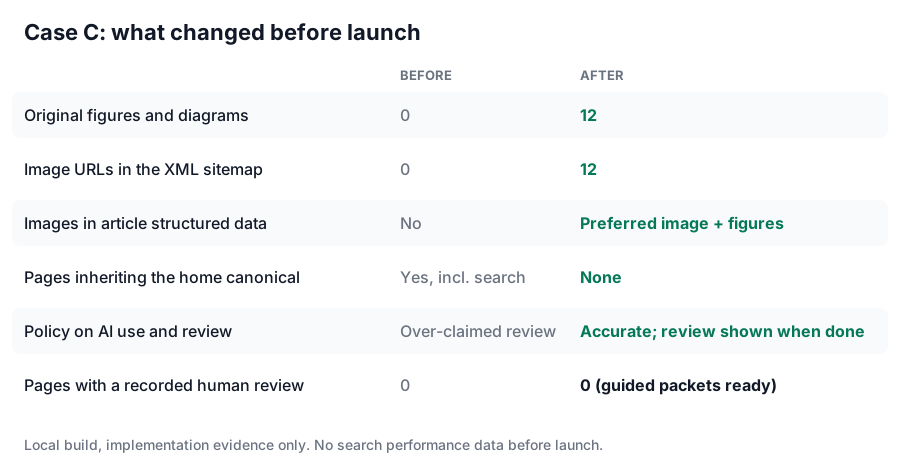
Figures from data already on the page. Twelve figures were drawn from tables, statistics and worked examples the chapters already cited: process diagrams, a worked accuracy example, timelines, a phase chart, bar charts of official statistics, a comparison grid and a chart of statistical uncertainty. Eleven of the seventeen chapters now have at least one. Each figure is generated from code, so a change to the data changes the chart. Each one has a caption that points back to its source table and a text alternative written to stand on its own. None is AI-generated imagery.
Figures that serve the page, the index, the book and a slide deck. The Markdown pipeline renders each image as a figure with a caption, its real dimensions and lazy loading. On phones the figure scrolls sideways instead of shrinking its text. The same figures go into the article structured data as image objects, next to the social preview image, so the preferred image and the figures agree. They also go into the XML sitemap and are exported as high-resolution PNGs for the print and ebook edition. A short briefing deck is built from the same figures and the chapters' key takeaways, so the slides cannot drift from the text.
One canonical per page. The site-wide canonical was removed. Pages now declare their own, and the noindexed search page declares none.
A review record that cannot be faked by the tooling. A page only shows "Reviewed by" when a named person adds their name and date to it. Structured data shows a reviewer only in that case. The editorial policy now describes the actual process: AI-assisted research and drafting, automated citation and style checks, and a final human review that each page displays once it has happened.
A guided human review
The review step is the one most often skipped, because "read it again" is not a task anyone can finish. So each page gets a review packet. It includes a checklist, the page's metadata, every cited sentence grouped under its source link, and every figure with its caption and text alternative. The reviewer works through the sources one at a time instead of rereading the page in order.
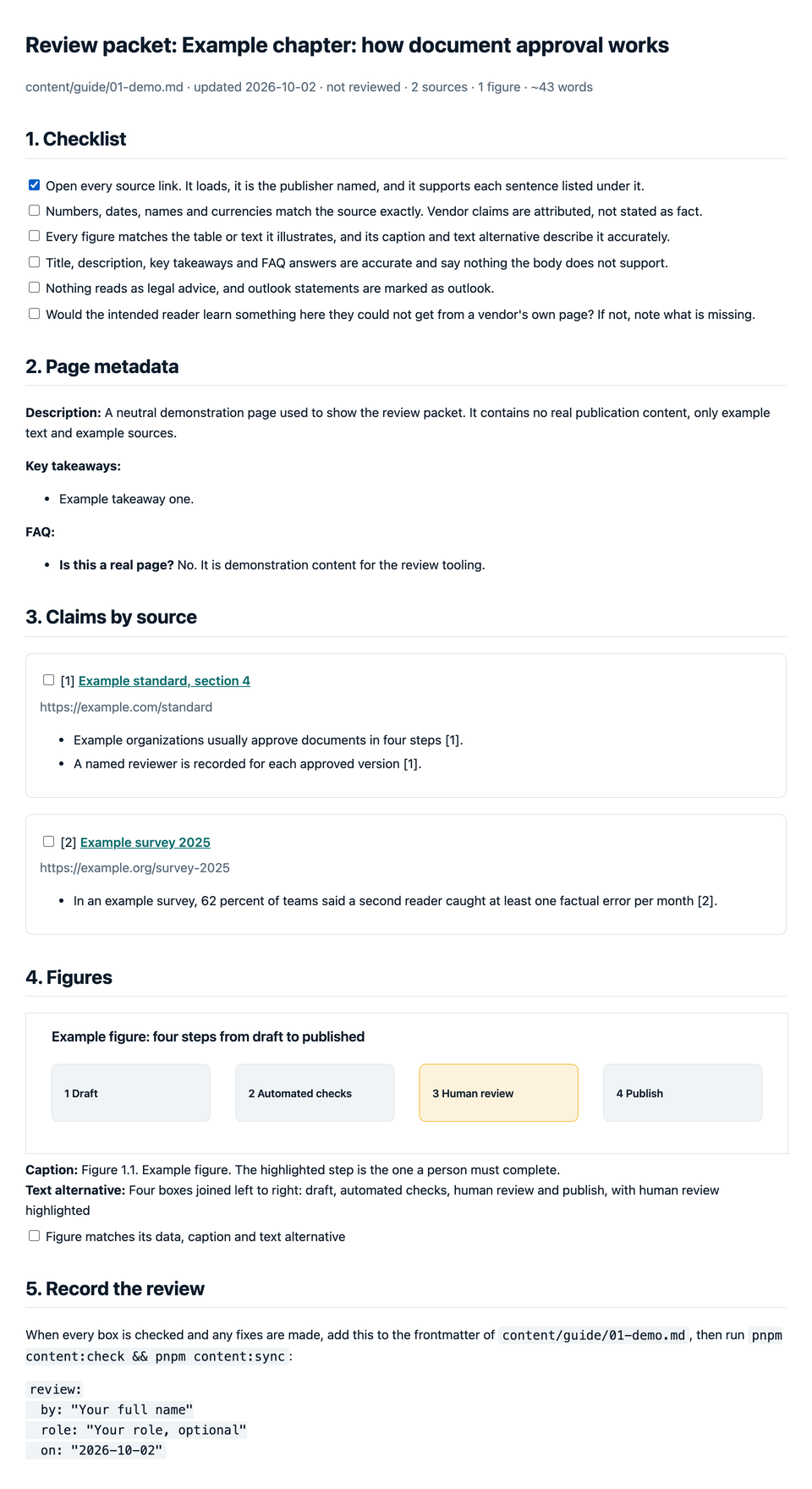
The packet above was generated for a demonstration page with example sources, not for the guide itself.
The queue reports how many pages carry a current review and flags any page edited after its review date. At the end of this work the count was zero, and that is what the site says: pages without the reviewed line have passed automated checks only.
What we did not do
- No llms.txt work aimed at Google. The file already existed for other services. Google says it does not use it, so it was not treated as a search task.
- No FAQ rich result expectations. Google deprecated FAQ rich results in 2026. The accurate FAQ markup stayed, with no expected display benefit.
- No invented author. The publisher still needs to decide who signs the work. Until then the pages carry the organization name rather than a made-up person.
Limitations and next measurements
This is a pre-launch record. The changes were verified on a local build by inspecting rendered HTML, structured data, the sitemap and screenshots at desktop and phone widths. None of it shows that Google will crawl the figures, show them in AI features or send traffic.
After launch, the measures are the Search Console performance report, with and without the multimodal filter; the generative AI performance report from the first indexed pages; and the share of pages carrying a current human review. Google's September 2026 spam update was still rolling out when this work was done, so the launch baseline will be annotated with it.
The reusable method
- Read the current primary guidance and record its update dates before changing anything.
- Capture a baseline: screenshots, rendered structured data, sitemap and robots responses.
- Turn existing tables and worked examples into original figures with captions and text alternatives. Generate them from data, not by hand.
- Put the figures into the structured data and the sitemap, and make sure the preferred image matches the social image.
- Make the editorial policy describe what actually happens, and show a review only after a named person has done it.
- Give reviewers a packet organized by source, not by page order.
- State what the evidence shows and what it does not.