Directory sites in 2026: the business model, who actually profits, and a 5-question vetting framework
Indie devs are being pitched template-and-course bundles for AI directory sites by people whose revenue comes from selling the template, not from operating one. Here's the actual business model, where the money is at each layer, and a 5-question diagnostic for separating real opportunities from shovels-in-a-gold-rush plays.
LIPAI WANG · · updated
There's a recommendation chain spreading fast in indie communities in 2026: launch a directory site. Buy a template. Pick the AI-tools niche. SEO will do the rest. The pitch arrives wrapped in screenshots of revenue dashboards and gets framed as a low-effort, high-leverage play.
About half of what's in the pitch is true. The other half is structured to sell you a template.
I've been on the receiving end of this pitch from multiple sources recently and went looking carefully at who is actually making money operating directory sites versus who is making money selling people the tools to launch them. The asymmetry between those two groups is the entire story.
This article is the actual business model, where the money is at each layer of the directory ecosystem, and a five-question framework for vetting the pitch before you build.
The business model, honestly
A directory site lists external resources — tools, services, products — and monetizes through some combination of six paths:
Affiliate commissions. Listed tools with referral programs kick back when a visitor signs up. AI tool affiliates pay $5–$50 per signup; SaaS tools sometimes pay 20–30% recurring. This is the most-cited revenue path in directory pitches.
Paid listings or featured slots. Tools pay $50–$500 per month to be highlighted, badged, or placed first. Only works once the directory has enough traffic to be worth bidding for.
Display ads. AdSense, Mediavine, Carbon Ads. Requires substantial traffic — Mediavine wants 50k sessions per month minimum, and that's roughly the cutoff where this revenue path even starts to matter.
Lead generation. Qualified leads sold to listed vendors. Higher-margin than affiliate, but operationally heavier — you need a real qualification process, not just a click.
Email list monetization. Capture emails from visitors, sell newsletter sponsorships at $100–$1,000 per send at meaningful list sizes. The email list is often more valuable than the directory itself.
Upsell to a course, community, or template. The directory is a top-of-funnel; the real revenue comes from selling people the playbook to launch their own. This is by far the highest-margin path, and it's the one most directory-pitch evangelists are actually running.
There's no single "directory revenue number." A working directory is a portfolio of these paths, weighted toward whatever the niche supports. A high-traffic generalist directory leans on display ads and affiliate. A niche professional directory leans on paid listings and lead gen. A creator-led directory leans on the email list and the upsell.
The pitch you're hearing tends to emphasize path 1 — affiliate — because it has the lowest perceived complexity and the strongest "passive income" connotation. The pitch rarely mentions that path 6 is what's paying the person making the pitch.
Who actually makes money at each layer
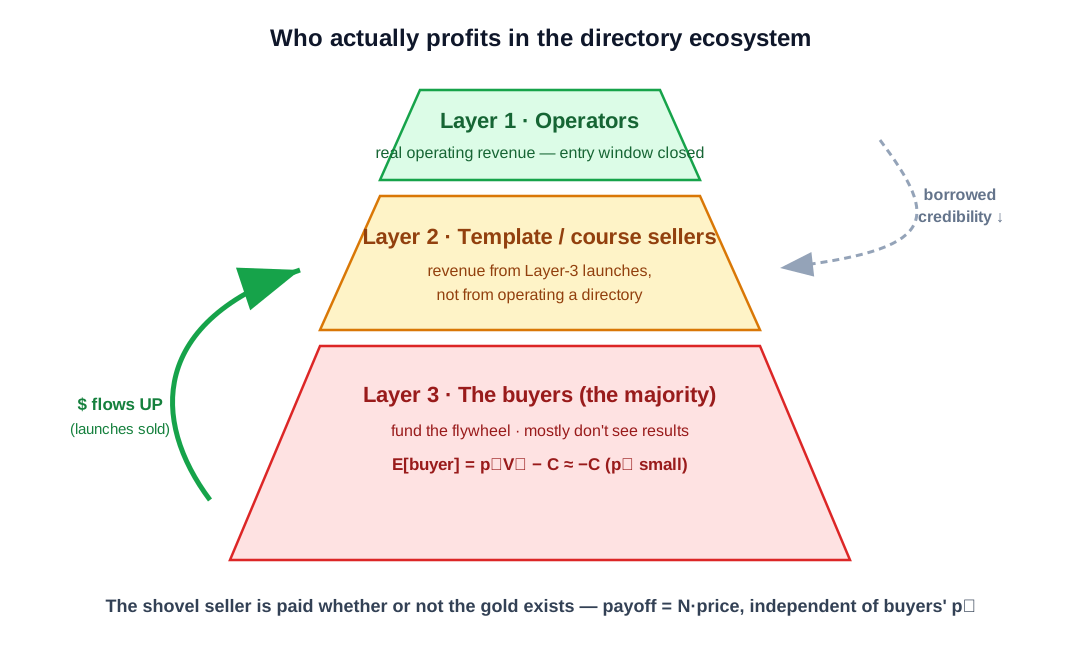
There are three layers in the directory ecosystem, and the economics get progressively worse as you move down.
Layer 1 — the original operators. Sites like TheresAnAIForThat, Futurepedia, OpenAlternative, Toolify. They launched in 2022–2023 when the AI-tools keyword cluster was unwon, built editorial credibility, accumulated backlinks, and now own substantial traffic. OpenAlternative crossed 1M+ unique visitors in 2025; TheresAnAIForThat is widely cited as having cleared exit-level revenue. Real money, real businesses. The entry window for matching them is closed.
Layer 2 — the template, course, and "launch playbook" sellers. People who package the technical and SEO stack for directory sites and sell it to indie devs for $100–$500 per template plus $200–$2,000 per course. Their revenue is mostly from layer 3 wanting to be layer 1. Their incentive is volume of launches, not student success rate. They cite the layer-1 examples as proof the model works. They almost never publish operator revenue from their own directory sites — only template and course sales.
Layer 3 — people who buy the template and launch. The vast majority. A small fraction succeed by adding genuine differentiation and distribution; the median outcome is a site that gets some launch traffic, plateaus at 1k–5k visits per month, never clears meaningful affiliate revenue, and is abandoned after 6–12 months. The traffic plateau happens because the template ships every buyer the same structural fingerprint, which Google's 2026 algorithm now actively suppresses (more on this in question 3 of the framework below).
The "make money with directories" narrative borrows credibility from layer 1 and converts it into layer-2 product sales. Layer 3 — the people actually buying — funds the whole flywheel and disproportionately doesn't see results.
This isn't a conspiracy. It's how shovels-in-a-gold-rush economies always work. The shovel sellers don't have to be malicious for the math to favor them. They just have to be loud, well-funded relative to the operators, and downstream of incentives that reward launch volume over outcome quality.
The 5-question vetting framework
Before you buy any template or follow any directory pitch, run it through these five questions. They're designed to surface where the pitch is strongest and where it relies on you not asking.
1. Who's telling you to do this, and what do they sell?
The cheapest question, and the most diagnostic. If the person pitching you also sells a template, a course, a community, or an "ultimate guide" for directory sites — they're layer 2, not layer 1. Their revenue is from your launch, not from their operation.
That doesn't automatically make the advice wrong. It does mean every claim should be weighted with the incentive in mind.
A good answer looks like: "I've operated three directory sites for four years, here's the public revenue dashboard, here's what I learned. The template is a side-effect of having done it." Rare but exists.
A bad answer looks like: "I've helped 1,000+ founders launch their directory!" Note the citation to launches, not operating revenue from those launches.
2. Show me the operator numbers, not the seller numbers
This is question 1 made specific. The seller will cite affiliate dashboards, exit prices, or generic "directories can make $10k/month" claims. Those numbers are all real for someone. The question is whether they're real for the person actually selling you the template.
Ask directly: "How much MRR does your own directory site clear, separate from your template and course revenue?"
If they can answer with specific numbers from a verifiable directory they operate, that's signal. If the answer pivots to "well, my students…" or "the industry is showing…" or "you should focus on the methodology," you have your answer. You're being sold by a layer-2 operator using layer-1 success stories as marketing.
This question filters out roughly 90% of directory-template pitches in under sixty seconds.
3. What's the template's structural fingerprint, and how do other deployments look?
Open three live sites that were launched from the same template and put them side by side in browser tabs:
- Do they have the same URL structure (
/tools/[slug],/categories/[slug],/compare/[a]-vs-[b])? - Do they have the same HTML structure on listing pages — same H tags in the same order, same component arrangement?
- Do they have the same metadata patterns, same OG image layout, same JSON-LD schema shape?
- Do they have the same "trending," "featured," "compare," "category" components in the same positions?
If you can't tell three sites apart without reading the brand name in the header, the template ships every buyer the same structural fingerprint. Google's March 2026 core update post-mortems explicitly named "pure template-with-variable substitution at scale" as a Scaled Content Abuse trigger. Sites matching that pattern lost 60–90% of traffic when the update rolled out. The penalty is algorithmic and persistent.
This isn't theoretical. The exact mechanism is covered in The Scaled Content Abuse trap — directory templates are the most concentrated current example of the pattern that update targets. You can run a single-page audit in the free penalty-check tool; the cross-page structural-similarity version of that check is the v1 upgrade and specifically catches template-clone sites.
The template seller will not bring this up. Their pitch landed before March 2026 and they're still running the same playbook.
4. What's the niche, and who already owns the head terms?
Open Google and search the head terms you'd be targeting. Common examples: best AI writing tools, AI for designers, AI tools for marketers, open source alternatives to [X].
If you see TheresAnAIForThat, Futurepedia, OpenAlternative, Toolify, or any established directory sitting at positions 1–5 with dedicated pages for your niche — they already own the niche. Your directory will compete for those same head terms from a backlink, brand, and content-depth deficit. The first-mover advantage in this category is not a small factor; it's most of the SEO outcome.
A niche worth entering looks like: top results are generic blog listicles, publications with no specific entity authority in the niche, or Reddit threads. That signals the AI-directory infrastructure hasn't been built for this niche yet — genuine opportunity.
A niche that's already won looks like: top 5 results are dedicated directory pages from established operators, with visibly recent updates and active editorial work. You will lose to them. The template doesn't fix this. The "AI tools for productivity" niche, specifically, is among the most-won keyword clusters on the internet right now.
5. What's your distribution edge outside SEO?
The honest truth about directory sites that succeeded in 2024–2026: every one of them had a distribution edge outside of pure SEO at launch.
OpenAlternative had open-source community credibility and a niche (open-source alternatives to closed tools) that's harder to AI-spam than "general AI tools." TheresAnAIForThat had Product Hunt timing and viral submission velocity early on. Futurepedia had a Twitter presence and newsletter distribution. The pattern repeats: SEO compounded on top of an existing distribution channel, not from scratch.
"I'll just build it and let SEO work" was a 2022 strategy. In 2026, SEO is the slowest and least predictable acquisition channel for new directory sites because the head terms are owned and the long tail is being algorithmically suppressed.
If your honest answer to "what's my distribution outside of SEO?" is "I don't know yet, I'll figure it out" — the math doesn't work. Plan for the directory to be your second or third product on top of an existing audience, not your first product hoping to acquire one.
What CAN actually work in 2026
For honesty: the directory model is not dead. Operators who clear real revenue in 2026 have all four of these:
- A niche the established operators don't cover at depth
- Original review content per listing — not just descriptions, but screenshots from actually using the tool, opinions, comparison tables, real testing notes
- Substantial structural variation from any template they started with — different URL patterns, different component structure, different metadata layout, different page templates that don't all read as "the same listing page filled with different variables"
- A distribution channel outside SEO that they own from day one
Pick a niche where you have specific domain expertise. Write real reviews, not AI-generated descriptions. Build the audience first; ship the directory as a product to that audience second. Plan for 6–12 months before SEO becomes a meaningful contributor.
That's the recipe. The "buy a template, launch in a weekend, let SEO work" pitch is a different recipe entirely. It cooks faster. The result you eat is worse.
The verdict
If you have an existing audience and a niche you genuinely know, the directory model is a reasonable second or third product. If you're starting from a template and a hopeful pick of a saturated niche, you're funding layer 2 of the directory ecosystem at the expense of yourself. The template sale completes regardless of your outcome.
The right vetting move is question 1 from this framework, applied recursively. Every voice telling you "directory sites are the play" — including this article — is worth asking: what do they sell, and what would change if they didn't?
When that question doesn't have a clean answer, lean on your skepticism. When it does, listen carefully.
If you've already built a directory site from a template and you're trying to figure out whether it's at penalty risk, run a recent page through the audit tool and check the named-author, Person schema, first-hand assets, and visible-dates checks specifically — those are the four protective signals most templates don't ship by default. The cross-page structural-similarity check is the bigger diagnostic and is coming in v1.