The Scaled Content Abuse trap: how batch AI content sinks indie sites in 2026
Two Google spam policies, scaled content abuse and the site reputation policy, plus core ranking's view of helpfulness, are what batch AI content workflows run into. Here's the failure pattern, what reported cases look like, and the 7-rule checklist that keeps your transcript-to-article workflow honest. Plus a free single-page self-review tool.
LIPAI WANG · · updated
I almost shipped a publishing workflow last month that could have sunk my domain. Record a video, transcribe it, run the transcript through an AI to produce a polished article, publish. Reasonable on the surface — I was working from my own expertise, not synthesizing topics from scratch. Then I went looking at what's actually happening to indie sites running similar pipelines in 2026, and the picture is brutal.
Two Google spam policies target exactly this failure mode, and Google's core ranking systems also assess helpfulness. Enforcement can be manual or algorithmic, and its reach varies: sometimes a page, sometimes a section, sometimes more. Google publishes no recovery timelines, so plan as if recovery takes longer than the fall.
This article is the failure pattern, what reported cases look like, the five trigger mechanisms, and the operational rules I now follow. There's also a free single-page self-review tool at the bottom that runs the same checks against any URL you paste in.
What "demotion" actually means in 2026
Two spam policies matter most here: scaled content abuse and the site reputation policy (Google's spam policies page now uses that heading; older write-ups call it "site reputation abuse"). Google's core ranking systems also assess helpfulness. They're worth naming separately because they trigger from different signals, and the remediation differs.
| Policy or system | What triggers it | Enforcement |
|---|---|---|
| Scaled content abuse (spam policy) | Many pages generated mainly to manipulate rankings rather than help people, giving little to no value, however they were made: generative AI without added value, scraped or automatically rewritten text, content stitched together from other sources, or the same content spread across several sites to hide the scale | Manual or algorithmic. Google's spam policies (page updated 2026-08-28) give no page-count or speed threshold |
| Site reputation policy (spam policy) | Third-party content published on a host site mainly to exploit the host's ranking signals. Third-party content is not a problem in itself, and Google lists forums and other user-generated content, wire services, syndicated news and reader-focused advertorials as outside scope | Human review. Outside the EEA: the affected pages may get a manual action. Inside the EEA: the affected pages may be treated separately from the main domain and ranked on their own merits, with no manual action |
| Core ranking systems (not a policy) | Little first-hand experience, thin or templated content that isn't helpful to readers | Continuous; Google folded the separate helpful content system into core ranking in March 2024 |
The trigger signals overlap heavily: if your content production pattern matches one, it often matches the others. Enforcement can be manual or algorithmic, and its reach varies. Under the site reputation policy, Google acts on the affected pages, not the whole site, and how it acts now depends on where you are: a manual action outside the European Economic Area, separate ranking of those pages inside it. Outside the EEA you will see the action in Search Console's Manual actions report and can ask for reconsideration once it is fixed. Check the spam policies page and the Search Status Dashboard for current updates. (The September 2026 spam update began on 2026-09-24; the dashboard still listed no completion when checked on 2026-10-06.)
What reported cases look like, in plain English
Reported cases describe steep drops weeks after a production spike and slow recoveries. Google publishes no timelines, so plan as if recovery takes longer than the fall.
- The shape is consistent across reported cases: high volume, thin depth, no named author with verifiable credentials, identical structure across pages.
- The drop is not instant. It can come long enough after the spike that you convince yourself it's working before it breaks. The Search Console graph looks like a hockey stick up, then a cliff.
- Recovery, when it happens, takes a substantive content rebuild, and there is no published timeline for it.
The thing that surprised me most when I went looking: the problem isn't that AI was used. Google's guidance on generative AI content says using automation is not itself against its policies; generating many pages without adding value for readers can be scaled content abuse. The spam policy says the same thing from the other side: it applies to low-value pages at scale no matter how they were created, by people, by AI or both. The penalty fires on the quality and shape of the output, not the origin of the words. That's what makes the trap interesting — and avoidable.
The five mechanisms that actually trigger it
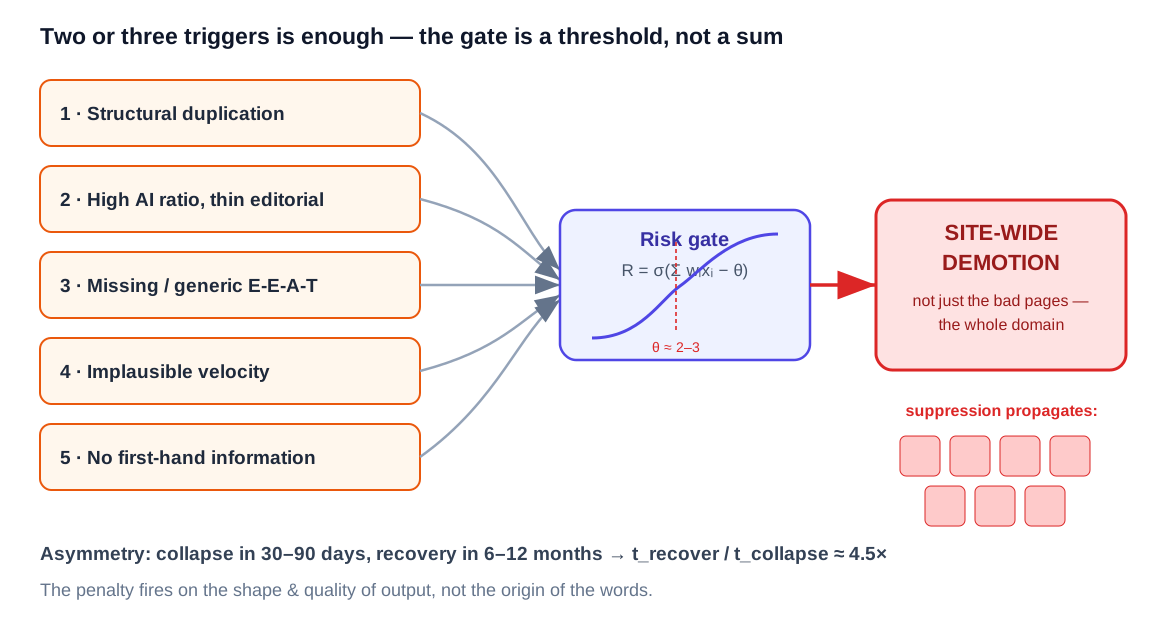
Read the Google policy text plus the indie-dev case studies carefully and the trigger signals collapse into five mechanisms. A site doesn't need to hit all five; in reported cases, several together are what hurt. That threshold is my illustration, not Google's formula.
1. Structural duplication. Every article on the site has the same shape: intro paragraph (3–4 sentences), three H2 sections (each with 2–3 paragraphs), bullet list, CTA. Default AI output makes this nearly inevitable unless you deliberately vary structure. Google's quality systems can identify "this site templatizes its content" without needing to identify any AI fingerprint at all. Same shape across many pages reads as a content farm regardless of how the seed material was generated.
2. High AI ratio, thin editorial overlay. The mechanism isn't "Google detected AI" — it's "the editorial layer is so thin that the content has no distinctive voice, no unique data points, no expert framing." When three articles in a row feel like the same generic mid-tier blog, the algorithm reaches the same conclusion you would.
3. No accountable author. No named author. Or there's a byline but no bio page, no credentials, no other content under that byline. Or the author "Sarah Mitchell" is a stock name that appears across dozens of unrelated AI-content sites and has no verifiable LinkedIn. To be clear about the evidence: Google asks whether readers can see who made a page and why, and says E-E-A-T is not itself a ranking factor. It does not say a missing bio or missing Person schema triggers enforcement. Treat these as signs a reviewer, and a reader, would notice, not as switches. An invented persona is a different matter: that is deception, and it is the one item here that is a problem on its own.
4. Publishing velocity disproportionate to plausible capacity. A solo indie dev publishing 15 articles per week is signaling, in plain text, that the production is not human-supervised. Google's quality rater guidelines (sections 4.6.5 and 4.6.6) describe scaled, low-effort content, and output that no plausible author could produce is one way it shows. This is hard to enforce algorithmically and easy to spot in a manual review.
5. No first-hand information. The article is a topical summary that could have been written by reading the first page of Google results. No original data, no specific examples from your own work, no screenshots from your own software, no quotes from someone you actually talked to. Google's guidance on creating helpful content asks exactly this: does the page add original information, or does it just summarize what others said? Its core ranking systems assess helpfulness (the separate helpful content system was folded into core ranking in March 2024).
Your transcript-to-AI workflow, risk-rated honestly
If you record your own videos, transcribe them, and run the transcripts through an AI to produce written articles — which is the workflow I was about to ship — you are not in the worst risk bucket. You're in the medium bucket, with one real protective factor and three real failure modes.
What protects you:
The transcript represents your own first-hand expertise. That's the "E" in E-E-A-T — Experience — and it is the original, first-hand information Google's helpful-content questions ask for. That it protects against demotion is our reading, not something Google documents (E-E-A-T is not itself a ranking factor). Pure synthetic AI content (where a model generates a topic from scratch with no grounding) has none of this. Your transcript-grounded content does. This is the single biggest reason this workflow is salvageable.
What still kills you if you're not careful:
- The AI strips your voice. Default model output is generic blog-prose. Run a real transcript through a model with no constraints and you get text that doesn't sound like you, doesn't preserve your specific examples, and doesn't carry the experience signal forward. The protective factor evaporates in the prompt.
- You publish both the transcript and the article. Now you have two pages competing for the same topic, with the article being a watered-down version of the transcript. Search engines have to pick one as canonical; often they pick neither, and both lose rankings.
- You scale this to many articles per week with no editorial layering. "Based on my own video" stops being protective somewhere around the fiftieth article in a month. The shape of the site reads as a content farm regardless of how the seed material was produced.
The 7 rules I now follow
This is what I've codified into a CONTENT_RULES.md in projects where I let an AI near publish. Borrow it.
1. AI as drafter, not publisher. Rewrite until the piece sounds like you and adds something only you know. There is no safe percentage.
2. One unique asset per article. Every published piece has at least one of: an original number I gathered myself, a screenshot from my own software, a code snippet I actually ran, a specific example from a project I actually worked on, or a quote from someone I actually spoke to. The AI cannot produce these. The article without one is the article Google's helpful-content guidance describes as adding little value.
3. Vary the structure. I don't templatize H2 counts, intro length, or CTA placement. Sometimes an article opens with a code block; sometimes with a quote; sometimes with three sentences and an H2. The cost of variation is small. The protective effect against the "structural duplication" signal is large.
4. Named author readers can check. Every long-form article has a named author with a bio page, a real LinkedIn or GitHub, and other work under that byline. Person markup labels the author for machines; Google recommends author markup to help it understand who wrote a page, not as a ranking or enforcement shield. If you're a solo operator, that author is you. If you have a team, it's someone real, not a fabricated persona.
5. Don't publish transcript and article as two competing pages. Merge them into one URL: the article, with the transcript as an expandable section, a linked appendix or just the video's caption track. If an old transcript URL exists, 301 it to the article, or keep it and point its rel="canonical" at the article. Google advises against using noindex to choose a canonical; redirects and rel="canonical" are the tools it names (official guidance, canonicalization). Two pages on the same topic are fine when they answer different questions.
6. Pace publishing to match plausible human capacity. For one person, a few substantive pieces per week is plausible; fifteen is hard to defend. There is no published safe rate. The right cap is whatever rate you could defend in a manual review — "yes, this is what a careful solo author produces" — not whatever rate your pipeline can technically generate.
7. Fact-check every generated field. Check the body, title, meta description, structured data and image alt text before publishing. Google's guidance on generative AI content asks for exactly this, because generated text can be confidently wrong. Tell readers when automation played a real part.
What I'm not going to do
A few things I considered and decided against, because the temptation to optimize them is real and the math is wrong.
- AI-content detectors as a gate. Tools like GPTZero or Originality.ai detect surface features that AI vendors patch every few months. Optimizing your output to pass a detector is a treadmill that doesn't address any of the five trigger mechanisms above. Skip it.
- "Humanizer" tools. Same problem one layer worse. They add typos and clumsy phrasing to lower detector scores. The article still has no unique data, no first-hand experience, and no real voice. The signals Google cares about are unaffected.
- Publishing under a pseudonym to dilute the byline. This doesn't help, whatever it does to rankings. Google asks whether readers can see who wrote a page; a real name is the honest answer, and invented personas are deceptive.
Check your own site, right now
I built a free single-page self-review tool that runs five of these checks against any URL you paste in. It can't see Google's systems and promises nothing about rankings; it checks your page against the patterns Google's spam policies describe. It checks for named author signals, Person schema, visible dates, Article schema, content depth, original assets (images, code blocks, tables), description and H1 quality, and a low-confidence AI-footprint heuristic. The output is a per-check pass/warn/fail scorecard plus a remediation list.
Run the single-page self-review →
The tool only audits one page at a time — full sitemap audits with cross-page structural-similarity detection are on the roadmap. But the single-page check catches most of the high-impact issues, and you can re-run it against your three most-recent articles in under a minute total. If all three score green, that's a good sign, not a guarantee. If two or more score red on the same checks, that's the pattern Google's scaled content abuse policy describes.
The TL;DR
Demotion under Google's scaled content abuse and site reputation policies, and weak results from core ranking's view of helpfulness, is the failure mode hitting indie devs hardest in 2026. Its reach varies by policy and action. Five trigger mechanisms — structural duplication, high AI ratio with thin editorial overlay, no accountable author, implausible velocity, no first-hand information — produce the same outcome from different angles. The transcript-from-your-own-video workflow is not in the worst bucket — your own experience is a real protective factor — but it only stays protective if you keep editorial pressure on the output. Seven rules above. The first one matters most: AI as drafter, not publisher. The last one keeps it honest: fact-check every generated field.
Run the free audit on three of your recent articles before you write the next one. The recovery from getting this wrong is much more expensive than the audit.