Category audit: how eight B2B vendors' websites hold up for AI search
A public-data audit by LIPAI WANG of eight competing B2B software vendors: crawler access, rendering, structured data, buyer evidence and comparison pages, checked against Google's current guidance.
Before you change your own site for AI search, look at the whole category. What your competitors publish, and fail to publish, tells you where original content can still stand out. This article reports a one-day audit by LIPAI WANG of eight vendors competing in one industrial B2B software category, using only their public websites. The vendors are labeled A to H. None is a client.
The audit is a snapshot of public pages on October 2, 2026. It describes what the sites do, not how they rank, and it does not test products.
What was checked
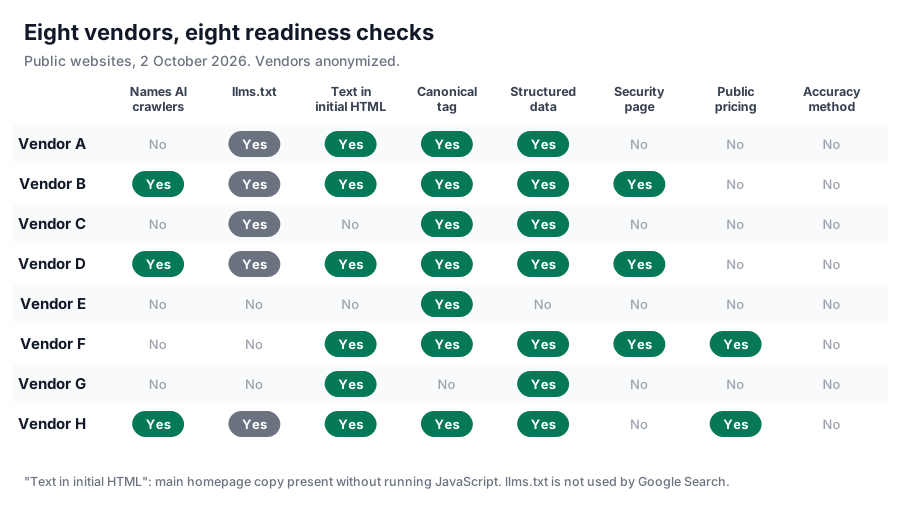
For each vendor: robots.txt rules for named AI crawlers, the XML sitemap, llms.txt, the homepage's canonical tag, social image, structured data and language attribute, whether the main text arrives in the initial HTML, and the buyer evidence a procurement team looks for first (security page, data processing agreement, certification claims, pricing, case studies and an explanation of how the product's accuracy is measured). Each check is a request a buyer, a crawler or an AI assistant could make, so the whole audit can be repeated in an afternoon.
Findings
1. Nobody blocks AI crawlers, and few say so on purpose
All eight sites allowed the AI crawlers we checked. Three named specific AI user agents in robots.txt and allowed them. The other five did not mention them at all, which allows them by default. Neither choice is wrong, but only the first is a decision. A written crawler policy that separates search crawlers from training crawlers is worth a few minutes.
2. llms.txt is common and does nothing for Google
Five of the eight publish llms.txt, and two of those also publish a full-text version. Google's AI optimization guide says Google Search does not use llms.txt or other special AI files. Keeping one for other services is harmless. Treating it as an AI search strategy is not a strategy.
3. Two sites hide their words from the initial HTML
Six vendors serve their main homepage text in the initial HTML. One sends about 270 visible words and loads the rest from a script payload. Its homepage also has no structured data and no language attribute. Another is a JavaScript application that puts its crawlable text in a block hidden from human visitors.
Google renders JavaScript, so the first site is a speed and reliability risk more than an indexing failure. The second is a different problem. Google's spam policies describe hidden text as content placed "solely to manipulate search engines". Text meant for crawlers should be the same text people see.
4. Structured data is present but uneven
Seven of the eight publish Organization or SoftwareApplication markup. Two attach ratings to a SoftwareApplication entity, a type Google supports if the ratings are genuine and visible on the page. One attaches reviews to its own Organization entity. Google's review snippet guidelines accept Organization reviews only on sites that review other organizations, so that markup earns nothing. One homepage still carries FAQPage markup, which no longer produces a rich result, and two describe a software company as a LocalBusiness. One homepage has no canonical tag.
None of these is a ranking emergency. All of them are signs that the markup was added once and never reviewed against what the page shows.
5. The buyer evidence gap is the real opportunity
Not one of the eight explains how its product's accuracy is measured. Three publish a security or trust page and only one publishes a data processing agreement. Two show public pricing. Case studies range from none to a few dozen.
This is the part of the audit that matters most for AI search. Google's guidance asks for original, non-commodity content. In this category, the questions every buyer asks (how accurate is it, how is our data handled, what does it cost) are answered by almost nobody in public. A vendor that publishes a clear accuracy method and its security documentation answers questions its competitors leave open, for people and for AI assistants.
6. Comparison pages at scale are a risk to manage
Two vendors run large sets of pages comparing themselves with named rivals: one has dozens, the other well over a hundred. Comparison pages can be genuinely useful. Produced from a template at that volume, they come close to what Google's rater guidelines call scaled, low-effort content, which its generative AI content guidance highlighted again on October 1, 2026. The test is whether each page says something specific and true that a buyer could not get from the template.
7. Sitemap dates that are not real
For two vendors, more than half of the blog URLs carry the same last-modified date. Google says it uses lastmod only when it is "consistently and verifiably" accurate. Stamping every URL with today's date teaches crawlers to ignore the field.
What to do with a category audit
- Run it before you write. List what every competitor publishes for buyers and where the gaps are. The gaps are your content plan.
- Fix the access basics once. Crawler policy, server-rendered text, one canonical per page, honest sitemap dates.
- Review markup against the visible page. Remove self-serving review markup and rich-result types that no longer display. Keep what accurately describes the page.
- Publish the evidence buyers ask for. Accuracy method, security and data processing documents, and pricing or a pricing model. This is the non-commodity content the category lacks.
- Hold comparison pages to a usefulness test. Fewer, specific, maintained pages beat templated volume.
Limitations
One day, public pages only, eight vendors in one category. Sitemaps can be incomplete and some vendors share documents only under NDA. We did not measure rankings, AI citations or traffic, and nothing here shows that fixing an item will change visibility. The point of the audit is to find what is missing and what is avoidable, not to predict results.