What AI search engines cite when B2B buyers ask for a shortlist
A one-day panel by LIPAI WANG of buyer questions in an industrial B2B software category across Google, Google AI Mode, ChatGPT, Bing Copilot and Claude: who supplies the answers, how rivals get described, and what vendors can fix.
When a buyer asks an AI assistant for a shortlist, the answer has to come from somewhere. This article reports a one-day panel by LIPAI WANG that asked the same buyer questions about one industrial B2B software category across five AI search experiences, then traced where each answer came from. The category is kept generic and no vendor is named.
The short version: in this category, most AI answers were assembled from pages the vendors wrote themselves, including pages written about their competitors. Independent sources were rare, and the weakest answers were about price and reviews.
The panel
Six unbranded buyer questions, written the way a procurement lead or operations manager might type them:
- A generic "best software for" question.
- Whether a product works with the equipment a site already has.
- A narrower detection question that sits next to a hardware category.
- A sector question limited to one region.
- A direct comparison of three named vendors.
- "How much does it cost?"
We also ran review lookups ("[vendor] reviews") for several vendors.
Each question ran once, on October 2, 2026, in:
- Google Search, including the AI Overview where one appeared.
- Google AI Mode, in a logged-in browser.
- ChatGPT, in a temporary, unpersonalized chat with web search on.
- Bing, using the Copilot Search answer at the top of the results.
- Claude, in an incognito chat with web search on.
Perplexity was on the list but blocked the question behind a sign-up prompt, so it is not included. Not every engine ran every question; the generic best-of question ran on all five.
For each answer we recorded the vendors named, the sources the engine cited and, for the two search engines, the organic results under the answer. Screenshots in this article are redacted: query text, answer text, source names, results and account details are pixelated, and only the engine's layout and our labels remain.
Findings
1. Vendor-written lists supply most of the answers
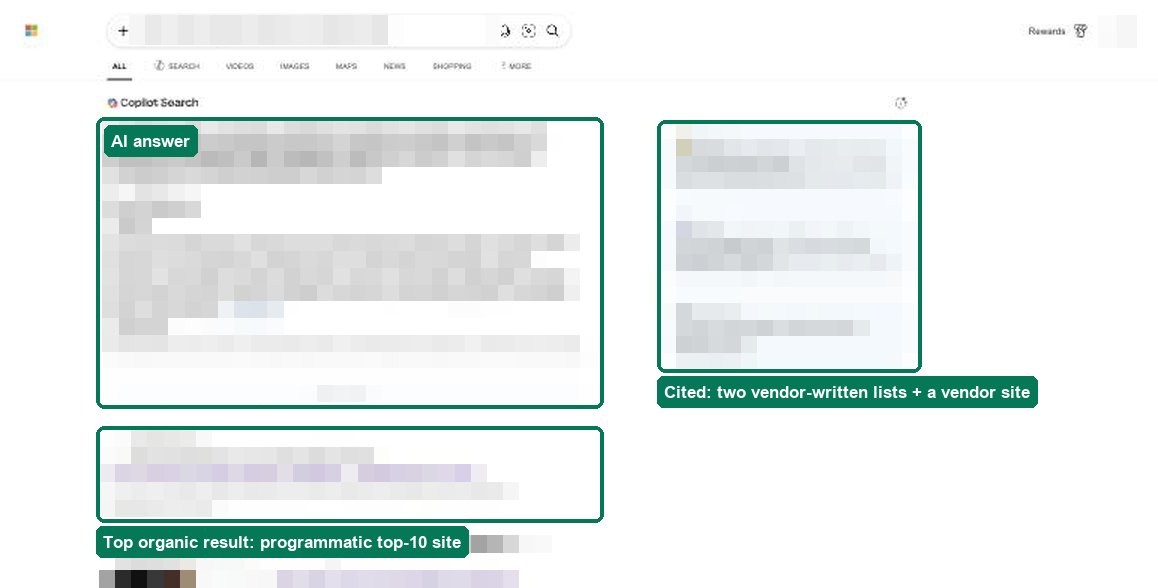
For the generic best-of question, most of the organic results on Google were vendor pages or "best of" lists published by vendors. Those lists usually put their author first. Bing's organic results were filled with programmatic "Top 10" sites, the kind that publish near-identical best-of pages for thousands of software categories.
The AI answers drew from the same pool. Bing's Copilot answer rested on two vendor-written lists plus vendor sites. Google AI Mode ranked one vendor first, citing that vendor's own "best software" page. ChatGPT cited only vendor-owned pages. The shortlists also disagreed: one vendor appeared in all five engines' answers, but the rest of each list varied, and Bing's shortlist was the most different.
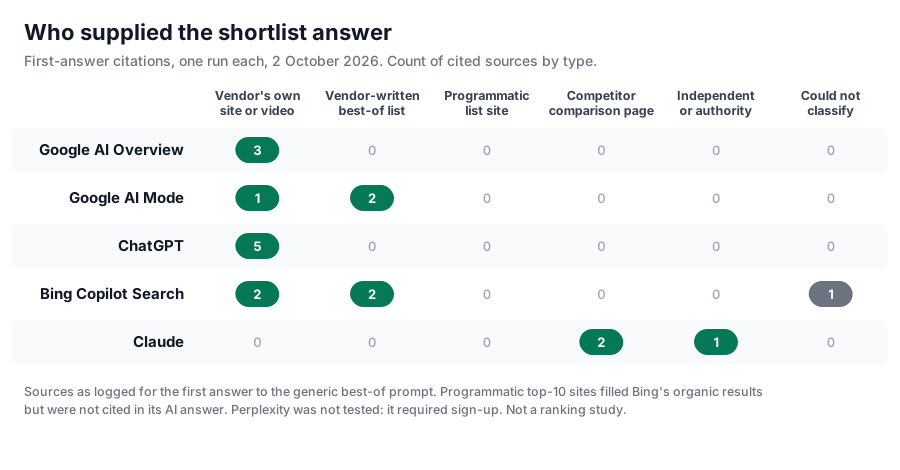
The chart counts cited sources per answer, as logged, for one run each. It is small and it is a snapshot. Its value is the pattern, not the numbers: an independent source appeared in one of five answers.
2. Competitors write the comparisons
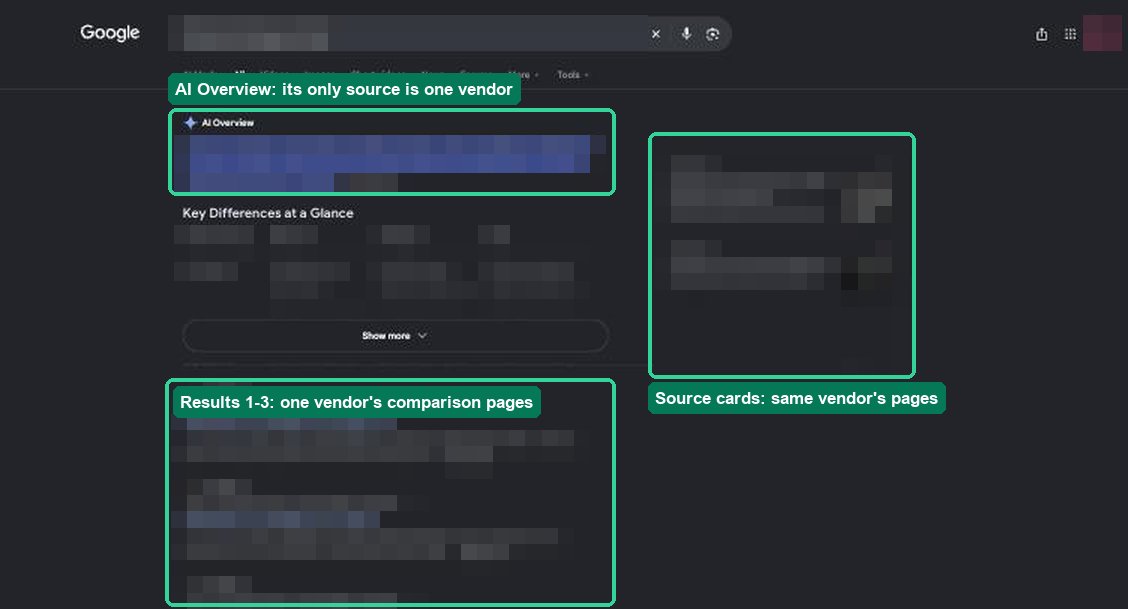
The three-vendor comparison question produced the clearest result of the panel. On Google, the top three organic results were comparison pages published by one vendor, a vendor that was not one of the three named in the question. Its pages were also the only source for the AI Overview. On Bing, the same vendor's comparison pages ranked first, followed by another vendor's comparison post.
That matters because the engines repeat what those pages say. Bing's Copilot answer described one of the three vendors as cloud-dependent and bandwidth-hungry, and the source for that weakness claim was a competitor's blog. It also repeated an accuracy figure a vendor publishes about itself. Claude, on the generic question, cited one vendor's pages for its descriptions of several rivals.
None of this is unusual or improper in itself. Comparison pages are a normal part of B2B marketing. The point is that if you do not describe yourself against your rivals, someone else will, and the AI answer will quote them.
3. Price answers disagreed by an order of magnitude
On the cost question, Google's AI Overview and Bing's Copilot gave the same low band: a few dollars per device per month. Neither cited a vendor from this category. Their sources were companies outside it, whose pricing has little to do with an industrial deployment.
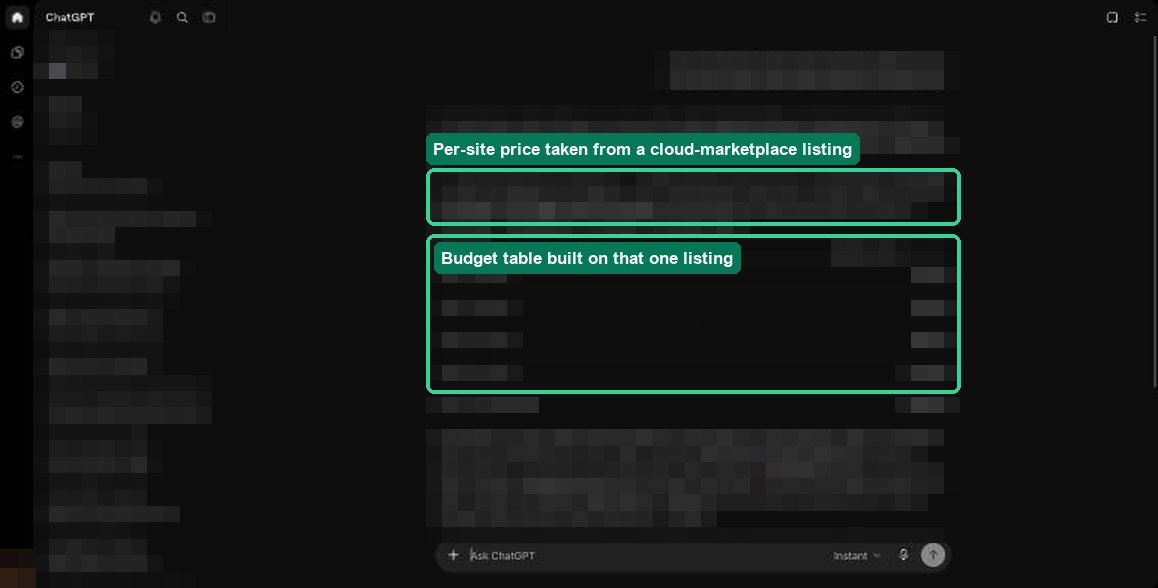
ChatGPT's answer was roughly ten times higher, expressed as a budget per site per year. Its most specific figure came from one vendor's public listing on a cloud marketplace, which shows a site fee and a per-device fee for a fixed contract term. ChatGPT then built a budget table from that single listing. It also used a software review site's "starting from" price for another vendor.
The vendor with the marketplace listing was the only one whose real price shaped any answer. Vendors that publish nothing were priced, in effect, by whatever loosely related source the engine found.
4. Review answers rest on very few reviews
The review lookups showed how thin the evidence behind a star rating can be. One AI Overview gave a vendor a rating of nearly five stars "on platforms like" a major review site, but the citation pointed to a marketplace listing with a handful of reviews. Another vendor's main review-site rating rested on a single-digit number of reviews. For a third vendor, the AI Overview blended product reviews with the company's employer ratings from a jobs site, which measure something else entirely.
Two more details stood out. A buyer's forum thread asking for candid feedback on one vendor ranked first for that vendor's review query. And for another vendor, a competitor's "review" of that vendor ranked second.
5. A small vendor was confused with other products
For one smaller vendor, the review lookup found no independent reviews at all. The results were filled with similarly named products from other companies, unrelated consumer brands and a scam-check page for a different website. The AI Overview fell back on the vendor's case studies and partnerships. This is an entity problem: the engine could not be sure which thing the buyer meant.
6. Only one assistant warned the buyer
Claude was the only engine that told the user that several of the best-of rankings were written by vendors who rank themselves first, and it pointed to an independent analyst firm instead. Even so, it still took its descriptions of several rivals from one vendor's pages. ChatGPT behaved differently on the regional sector question: it cited government statistics, a data protection regulator and an industry body, and named almost no vendors.
What to do if you sell B2B software
- Publish comparison pages a rival could not fault. If engines will quote comparison pages, the best defense is an honest one of your own: specific, dated, sourced claims about yourself and your competitors, including where a competitor is stronger. A page a rival could not reasonably dispute is more likely to survive scrutiny from buyers and from Google, whose guidance on helpful content asks whether content provides original information, reporting, research or analysis, and whether a reader will leave feeling they have learned enough to reach their goal. Fewer, maintained pages beat a template run across every rival.
- Publish pricing, or at least a pricing model. Say what drives the price (sites, devices, users, modules, contract term) and give a realistic range. If you leave the question open, the AI answer fills it from someone else's numbers.
- List on the marketplaces your buyers use. A cloud-marketplace listing was the most specific price evidence in this panel. If you sell through a marketplace, keep the listing accurate and complete.
- Earn third-party reviews, and do not mark up your own. A rating built on a handful of reviews is fragile. Ask real customers to review you on independent platforms. Google's review snippet guidelines limit Organization review markup to sites that review other organizations and treat employer ratings as a separate type, so self-reviews on your own site earn nothing.
- Fix your entity signals. Choose a product name that is not already taken, or always pair it with your company name. Add Organization markup with
sameAslinks to your official profiles, and keep the name, description and logo consistent across your site, marketplace listings, review profiles and social accounts.
Limitations
Each question ran once, on one day, in one browser and one location, so a repeat run could name different vendors and cite different sources. Google AI Mode ran in a logged-in browser and may have been personalized; the other assistants ran in temporary or incognito modes. Not every engine ran every question, and Perplexity could not be tested without signing up. The source counts in the chart are small and depend on our own classification of each source. This is not a ranking study, it covers one category, and nothing here shows that any change to a vendor's site would change what an engine says. It shows where the answers came from on the day we asked.